This site is intended for UK healthcare professionals.

Placebo (n = 175) | Fezolinetant 30 mg (n = 173) | Fezolinetant 45 mg (n = 174) | |
|---|---|---|---|
Week 4 | |||
LS mean change from baseline, mean (SE) | -2.3 (0.5) | -3.3 (0.5) | -4.1 (0.5) |
LS mean difference vs placebo (SE) | -- | -1.0 (0.7) | -1.8 (0.7) |
P-value vs placebo | -- | 0.16 | 0.008 |
Week 12 | |||
LS mean change from baseline, mean (SE) | -3.2 (0.5) | -3.7 (0.6) | -4.2 (0.5) |
LS mean difference vs placebo (SE) | -- | -0.5 (0.8) | -1.1 (0.7) |
P-value vs placebo | -- | 0.49 | 0.16 |
Table 2. Mean change in PROMIS SD SF 8b total scorea from baseline to Weeks 4 and 12 of SKYLIGHT 21
Placebo (n = 167) | Fezolinetant 30 mg (n = 166) | Fezolinetant 45 mg (n = 167) | |
|---|---|---|---|
Week 4 | |||
LS mean change from baseline, mean (SE) | -2.6 (0.5) | -3.9 (0.5) | -5.3 (0.5) |
LS mean difference vs placebo (SE) | -- | -1.30 (0.7) | -2.7 (0.7) |
P-value vs placebo | -- | 0.082 | < 0.001 |
Week 12 | |||
LS mean change from baseline, mean (SE) | -3.4 (0.5) | -4.1 (0.5) | -5.5 (0.5) |
LS mean difference vs placebo (SE) | -- | -0.7 (0.7) | -2.0 (0.7) |
P-value vs placebo | -- | 0.381 | 0.007 |
Figure 1. Change in PROMIS SD SF 8b total score from baseline to Weeks 4 and 12 in a pooled analysis of SKYLIGHT 1 and 24
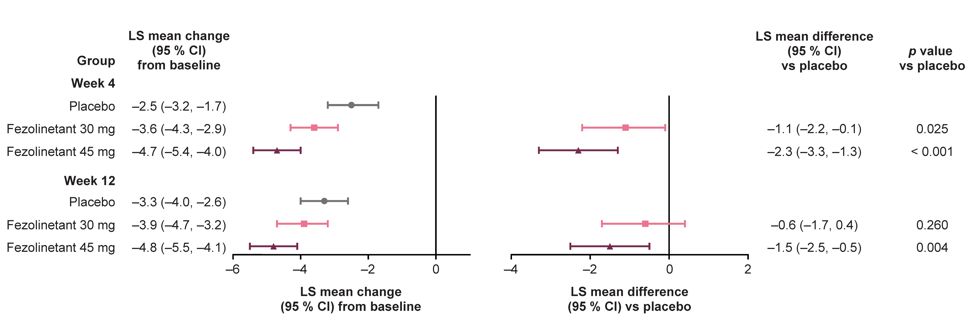
Figure 2. Change in PROMIS SRI SF 8a total score from baseline to Weeks 4 and 12 in a pooled analysis of SKYLIGHT 1 and 24
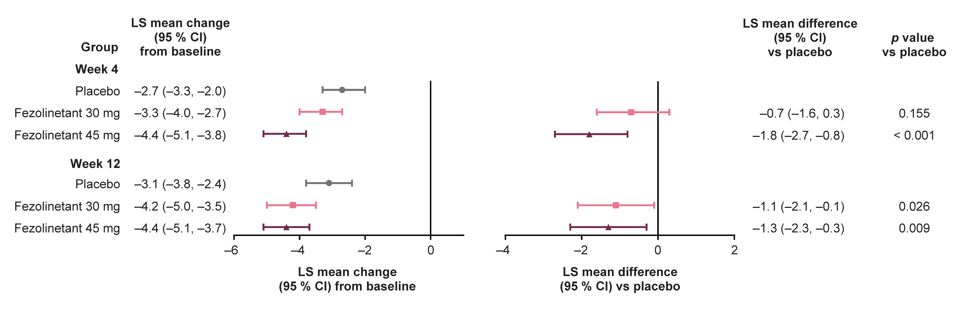
Figure 3. Distribution of the PGI-C SD at Weeks 4 and 12 in a pooled analysis of SKYLIGHT 1 and 24
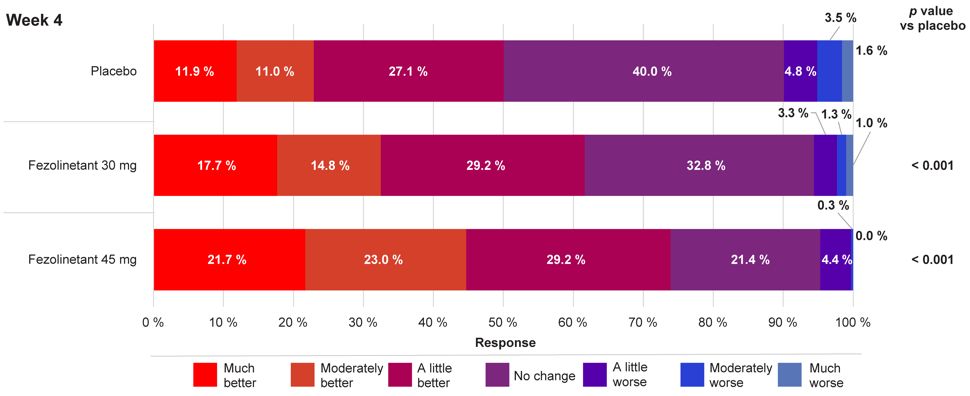
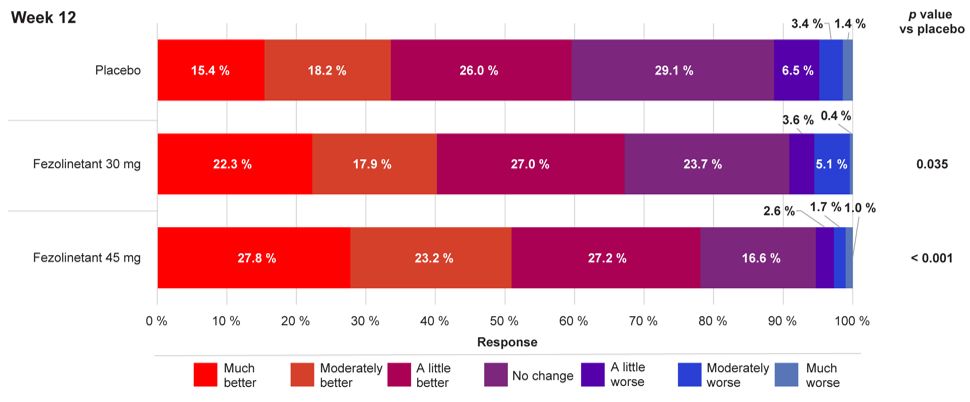
Fezolinetant 30 mg: n = 339, fezolinetant 45 mg: n = 341, placebo: n = 342.
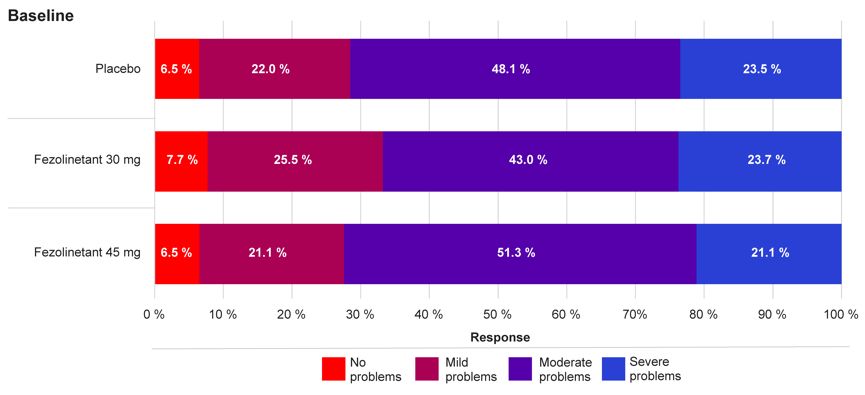
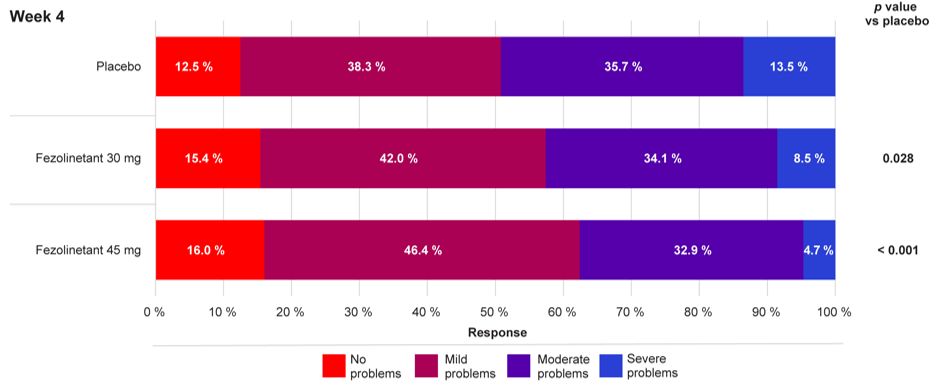
Please note that these pooled analyses are not adjusted for multiplicity; p values therefore do not confer statistical significance and should be considered indicative, not confirmatory, and are for the purposes of hypothesis generation.
Adapted from: Shapiro M, Maturitas 2024.
Figure 4. Distribution of the PGI-S SD at baseline, Week 4, and Week 12 in a pooled analysis of SKYLIGHT 1 and 24
Johnson KA, Martin N, Nappi RE, et al. Efficacy and Safety of Fezolinetant in Moderate to Severe Vasomotor Symptoms Associated With Menopause: A Phase 3 RCT. J Clin Endocr Metab. 2023;108(8):1981-1997. Available at: https://doi.org/10.1210/clinem/dgad058.
Lederman S, Ottery FD, Cano A, et al. Fezolinetant for treatment of moderate-to-severe vasomotor symptoms associated with menopause (SKYLIGHT 1): a phase 3 randomised controlled study. Lancet. 2023;401(10382):1091-1102. Available at: https://doi.org/10.1016/s0140-6736(23)00085-5.
Data on file.
Shapiro M, Cano A, Nappi RE, et al. Effect of fezolinetant on sleep disturbance and impairment during treatment of vasomotor symptoms due to menopause. Maturitas. 2024; Available at: https://doi.org/10.1016/j.maturitas.2024.107999.